I’ve seen a pattern in the Wonder Pick card shuffle and wanted to know if anyone else has noticed this.
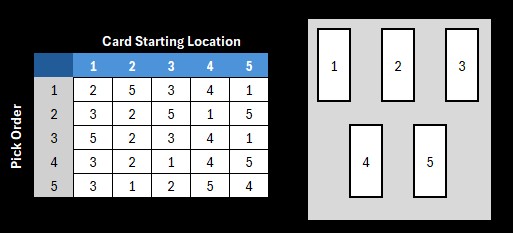
Looking at the card you want, the pick pattern seems to be in this order:
Card in same postion
Card moves one space clockwise
Card move one space counter clockwise
Card moves two spaces clockwise
Card moves two spaces counter clockwise.
Then the pattern starts over.
I’ve used this to some success by picking a free wonder pick and then a 1 cost wonder pick. This establishes where I am in the pattern. The next pick is the most valuable card I want.
Maybe we could use this thread to paste Screenshots after and before the pick, and some programmer may be able to analyze all the results to see if there is a pattern?
It is already showned that there are actually no randomness in computing, and I do not believe that they are using physical phenomena to determine the outcome of a pickdraw in Nintendo.
As a developer, I can promise you, there is no way that the development team at Nintendo went through so much effort to create a sophisticated pattern instead of using a super simple random function. Obviously, Nintendo wants an app that cannot be cheated, why would they build in some pattern?
What you are experiencing is called Apophenia. Humans see patterns in a lot of things that don’t have a pattern. More relevant, gamblers may imagine that they see patterns in the numbers that appear in lotteries, card games, or roulette wheels, where no such patterns exist. A common example of this is the gambler’s fallacy.
I think it is well known for gamers that video game companies have tried to generate such illusion of randomness by incorporating in the calculation, certain actions of the game to give the illusion of true randomness. That is why certain pokemon games when played using very specific actions in very specific sequences trigger very specific events that were supposed to be “random” like pokemon encounters or things like that.
Probably now we have some random generators that are harder to identify, maybe in the future, as it happened with the past so called “randomness”, it may be debunked, as the processing capacity of computers scales.
You are correct to say that truly random numbers don’t exist. However, the pseudo-random numbers (PRNG) we use in programming every day are random enough for most applications and certainly random enough for a simple card game.
For things like cryptography we use Cryptographically Secure Pseudorandom Number Generator (CSPRNG) , which is still not ‘truly random’ but good enough for securing your bank account and all the important things on the internet.
There is no way, a human brain can find any pattern in the PRNG. So in the context of the wonder pick, a simple pattern (left, right, etc), does not make any sense in this context of PRNG.
Truly random numbers don’t exist, that doesn’t mean you can guess the next wonder pick position. That is Apophenia (and a bit of wishful thinking).
While I appreciate your input as a developer, I think you might be oversimplifying my argument and focusing heavily on the psychological aspect. I’m not simply claiming that I see a pattern based on gut feeling, which is where Apophenia comes into play.
I am just open to the possibility of someone being able to find a pattern through rigorous data analysis in the future, or other methods. The goal isn’t to rely on human intuition to spot obvious sequences (that is why I personally claimed that the post goal was debunked).
The comments on this got me thinking more about it. So, I sat down and actually logged my last 5 picks (all the Wonder Picks I had left). Not enough to make any conclusions other than my initial hypothesis is totally wrong. LOL
Marcel is right, definitely some apophenia going on.
It is interesting that these locations are currently outperforming the rest right now:
1 → 3
2 → 2
4 → 4
Here is the raw data from those picks if you are interested:
I even think that the wonder pick is predetermined on the backend. The card is already assigned on the backend before you pick your slot. Then when you pick your slot it shows the predetermined card there and the others in random order.
The reason why I think that is because that is the only way to prevent any form of cheating by spying on the network data or reading the random memory of your phone to determine the position of the cards.
It is the same with the card pack carousel. It doesn’t matter which one you open.
One thing that adds a wrinkle here is the sneak peek event.
If the game selects a card for me, does it show it in the sneak peak? Or does it leave it to the other four, to then ‘randomly’ allocate.
What if I then choose to take what was shown in the sneak peek, even if it wasn’t the one I was ‘supposed’ to get.
The other thing it assumes that the game knows which card I want from the pick. If the best card in the pack is an EX for example, and I sneak peak slot #1 which shows a lesser card, I still now have the option of selecting that card or not (let’s say it’s the only one I’m missing for example, or I want another copy for my decks).
I know nothing about programming, but would it make more sense to add a true sneak peek function into the existing system of functionally random choice, or coming up with an alternate system for the week here or there that sneak peek is active for?
Yes! That was also bothering me when the sneak peak arrived, so I thought about it. Of course it is undisclosed how this all works, so this is pure speculation. If I would build this, what I would do is assign a second ‘backup’ card on the backend when you get a sneak peak.
Then, on the frontend, the first card you pick is always the card that was already assigned like normal wonder picks, but in the sneak peak version you can switch to another card which is the assigned backup card.
Essentially this would mean you just get the choice between 2 cards in this case.
The reason why you would do this is to prevent cheating like described above, but also in case someone disconnects before picking anything. In case your internet connection is disconnected you always are still assigned a card, which is the primary card that was already assigned and it doesn’t matter if you wonder pick or sneak peak. You can try this yourself by killing the app before picking anything and restarting it.
Yeah either we receive 2 cards from the backend or we are essentially wonder picking 2 times (the 2nd time over 4 cards instead of 5 if we change our selection).
But the way the cards are displayed when the selection is done might have a pattern like this thread implies… it just doesn’t matter for the result.
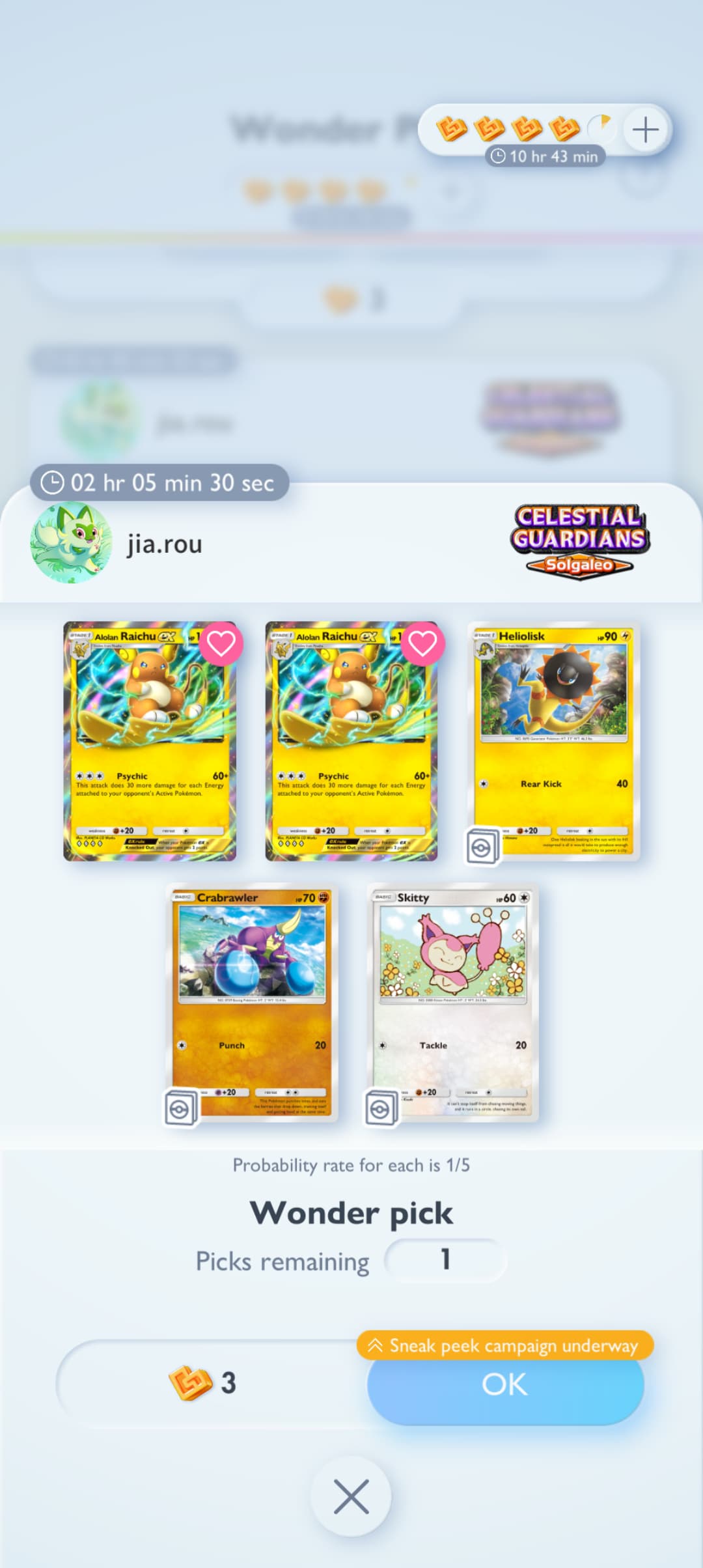
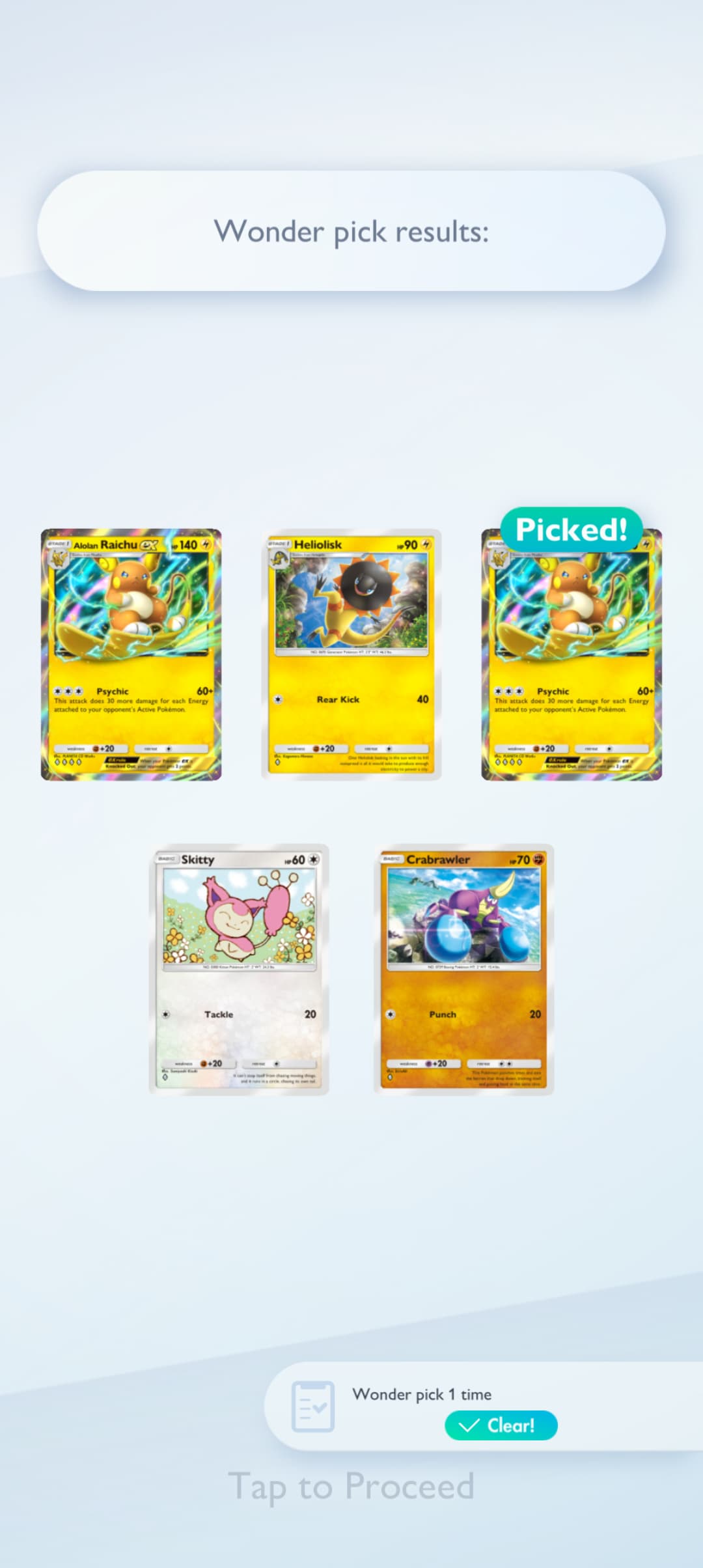

 airplane mode during wonder pick?